Tissue Processing
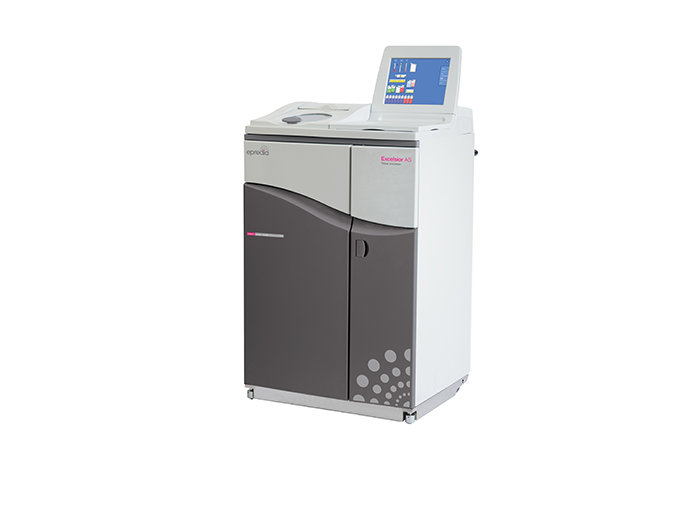
Excelsior AS Tissue Processor
Overview
Enhanced Tissue Quality
- Cassette baskets are gently rotated inside the circular chamber, providing more effective agitation than an impeller
- Reagents can be preheated to up to 35°C, minimizing tissue shock and facilitating reagent penetration
- Baskets can be used for microwave secondary fixation
Significant Reagent Cost Savings
- By directly measuring the alcohol quality during every run, reagents can be replaced when completely exhausted, reducing waste
- Automatic reagent rotation further extends reagent life using a proven system
- Direct quality measurement and automatic rotation together can lead to reagent savings of 75% or more
Versatile, efficient Workflow
- Reduce maintenance time by replacing one bottle of each reagent rather than all of them
- New reagents are drawn directly into the processor from the supplier’s bottles. No pouring – no mess – no fumes
- Run rapid biopsies during the day and conventional programs overnight
Safe for the Tissue – safe for the Operator
- When the chamber is opened, a downdraft fan pulls fumes through a filter to protect users from chemical exposure
- Fumes from the cabinet are extracted through filters to protect users from alcohol, xylene, and formaldehyde
- Remove waste paraffin by simply discarding a plastic tray – no paraffin spillage and burns
- Battery back-up protects against power outages
- Compatible with IPA xylene-free processes as well as conventional reagents
Simple to learn and operate
- The all-new touch screen interface is intuitive and easy to learn
- With intelligent software, it is easier to avoid mistakes that affect tissue quality
- Engineered for reliability and peace of mind
- Choice between random basked and organized basket
FAQs
Tissue processing prepares fixed tissue for embedding in paraffin wax. The tissue passes through dehydrating and clearing reagents before paraffin infiltrates it. This allows the sample to be embedded, cut into thin sections, stained, and examined by a pathologist.
Good tissue processing preserves the structure of a sample and makes it possible to produce sections suitable for microscopic examination. Consistent processing helps pathologists assess tissue features that may be relevant and necessary for diagnosis.
The main steps are dehydration, clearing, and paraffin infiltration, following fixation. Labs can process tissue manually or use an automated tissue processor, such as Revos. Automated systems use different approaches to move tissue or reagents through each stage, with protocols selected according to the specimen and your lab’s workflow.
Epredia offers tissue processors, embedding equipment, reagents, and paraffin for the histology workflow. Tissue processors include Revos, Excelsior AS, and STP 120, giving labs options for different processing needs.
Our portfolio represents the entire histology workflow, from specimen collection to processing, sectioning to staining, and advanced imaging to archiving. Every second of every hour of every day, 48 of our products are employed in the battle against cancer. Customers put their trust in Epredia over a billion times every year.